Showing posts with label Fruit Veg. Show all posts

Wednesday, April 18, 2012

Wild Thing! Redeeming the weeds

Before the peas, before the onions, before the wee beans start poking their heads up out of the dirt, we start harvesting.  Long before any of our intentional and work intensive crops start popping up, there is a wonderful spring bounty of  'work free' wild plants that are delicious, and so so good for you, and all we had to do to get them was know how to recognise them...Most of you know most of these plants, and most of you call them by the generic term..."Weeds".  Well, I call them supper!

I love the idea of wild food, of being able to walk into a field anywhere and find something to eat. Its free, its sustainable, it doesn't take any work or any manipulation or exploitation of the soil...So here's a guide to a few of my favourites that we are eating right now.  Lots of these are very common, and grow everywhere -- see how many you can recognise, and next time you take a walk in the park, come home with a salad for supper. (but wash it, cause dog's pee in the park, and as far as I know dog pee isn't so very nutritious)

Ribwart 

1) Plantago Lanceoloto (Piantaggine, or Ribwart in english).  Grows everywhere.  Very young shoots are excellent raw in salad.  As they get bigger, they should be boiled and prepared like spinach.  By the time its flowering, its usually too late, still edible but not too tasty.  The plant does all kinds of good things for you, including: Diuretic, anti-inflammatory, good for respiratory problems.  Also great for external use on bug bites and blisters, rub the leaves on the wound.  There is also a variety with round wide leaves, just as efficacious, just as commestible, but not quite as tasty.

Yarrow
2)Achillea Millefolium, also known as yarrow, can be eaten raw and can be dried to make delicious teas.  Its medicinal effects are numerous, and its one of the more important herbs in the herbalist's medicine box.  Our fields are absolutely full of it, and the goats love it too!  There are a million different types of yarrow, and you can recognise it by the fuzzy hairy leaves.  Like most wild greens, by the time it flowers, the leaves aren't tasty anymore, but if you notice the flowers then try and remember the spot for next year...See wikipedia for the effects:  http://en.wikipedia.org/wiki/Achillea_millefolium#Herbal_medicine

Hops shoots
3) humulus lupulus -- hops: This is a special favourite...we have the woods on the hillside behind the small farmhouse FULL of a spiny thorny horrid viney bush that kind of looks like blackberry from a distance, but doesn't make yummy berries, and we were all ready to just chop it all down and chip it and turn it into mulch, the nasty stuff...and then we discovered just in time to save it...its wild hops!  Super duper scrumcious.  In spring we eat the little spear shaped jets of new growth, just like asparagus.  Its absolutely delicious -- I made a risotto with it that even Mia had three portions of, it was so delicious.  And of course, when the flowers come, they are excellent for tea...and beer!!  Don't know if we get to the beer stage, but its nice to know we could if wanted to!

nettles
4) Urtica dioica -- Nettles:  This one is my absolute favourite.  Perhaps because it has had to come so far in my esteem -- all the way from hated nasty-stinging-horrible-makes-weed-killer-seem-sensible-awful-yucky-nettles to WOOOOHOO-look-how-many-nettles-we-have-this-year!!!  Or maybe just because it so darn good!  Its sting comes from tiny firm hairs on the stem and under the leaves that work like mini hypodermic needles, injecting a tiny amount of irritant from each one.  If you shake the plant around with a stick, the needles break and the sting disappears (though its impossible to get them all, so I still use gloves).  Once boiled, the sting completely disappears, and you are left with one of the most delicious and nutritious plants there is.  WAY more nutritious than spinach, and tastier too, and it doesn't take up any room in the garden, no weeding, no sowing...just harvesting.  Nettles are FULL of  vitamins A, C, iron, potassium, manganese, and calcium.  They are purifying and detoxifying, perfect for a spring clean-out of your entire body.  


preparing nettle balls for freezer
And they are DELICIOUS.  Boil first, then chop up into pieces, and use the pieces in an omelette or risotto.  Or just dress with a bit of olive oil and lemon juice, and eat like greens.  AND DON'T THROW OUT THE WATER!  It is delicious as a broth, added to soups (add the leaves to soups too) and stews -- I take the reduced broth and put it in popsicle moulds in the freezer, then pop out into a freezer bag, and I have premade portions of the best broth ever to use all year long.  It is also wonderful dried in a tea.  Gab collected 8 kgs of it for me this year, and I have pre-boiled it and pressed it into balls, squeezing out the excess water, and frozen the balls.  Once frozen, they are popped into freezer bags, and once again, pre-prepared portions to use all year long -- I just grab a few balls to throw into whatever soup or stew or risotto.  And we can leave off the spinach, labour and space intensive, and when there's nettles, who wants spinach anyway!!


lambs quarters
5) Chenopodum Album (farinaccia or lamb's quarters in english):  Apart from being delicious in salads or cooked as spinach, the Chenopodum Album is one of the oldest known plants used as food by humans...they found some in both the stomach and the purse of the frozen prehistoric guy in the alps. So I eat thinking "oog oog, caveman food yummmm".  Its also very popular in India as a food crop, called Bathua and in many traditional indian recipes.  It is used world over also for animal feed, and is especially helpful for ruminants.


Campion, ready to eat
6) Silene vulgaris, in english, campion or catchfly  Here locally, its known as verzuli and is especially prized by the locals in Sabbio. This is a plant so common in Ontario, as soon as I saw the flowers, i remember seeing it everywhere when i was growing up.  ITS 
DELICIOUS. Like a super sweet and slightly mustardy cabbage.  The fresh new 
leaves raw in salads, and in theory the larger older leaves boiled or fried in omelettes and such,
silene Vulgaris, the flowers

but young and raw it is so delicious, that with us the only plants that get to a stately boil-able age are the ones we leave for seeding for next year; so I've never tried them that way!  Again, like most spring greens, by the time the flowers come, its too late to eat the leaves.  They are good from about 5cm  until they are about 15cm high, then they start getting tough and ewww.


Dandelion
7) And...tip of the top, cream of the crop, its DANDELION and there we stop...Taraxacum Officinale.  When I think of the dandelion killer we used to use on the lawn when i was a kid....sigh...the waste, the waste! Use the leaves boiled like greens or spinach, and use the buds  preserved under oil or vinegar, as capers.   Dandelion leaves are full of vitamins B1, B2, C, E,  good sources of calciumpotassiumiron and manganese. It is considered a Diuretic, purifying, and used in rheumatism cures.  It is an antispasmodic, also used for dispepsia and loss of apetite.  


good to eat now!
And its not just good on the table -- its good for the whole ecosystem on the farm.  Bees love the flowers, and it strengthens bee colonies.  Its tap roots bring up nutrients from the deeper soil into the shallow levels of the topsoil, enriching the upper levels of soil for the surrounding plants.  It attracts predatory insects that help keep the real pests at bay, so its actually good for companion planting.  Weed schmeed!  I think we should have lawns that are all dandelion and hardly any grass...actually, my lawn is pretty much there already!!!


Another interesting thing about dandelion -- there are a number of plants that look just like it, at least by the leaves alone (and, yet again, by the time you see the flowers, its too late to eat the leaves). Like Chicory (use roots to make coffee substitute) But have no fear -- ALL the other similar plants are also edible!  Not all as tasty or as nutritious, perhaps, but all perfectly digestible and safe.


And here are some other surprises -- common plants and flowers that are actually edible, but i'm tired of the detail so I'm just tacking them all on the end...
Queen Anne's Lace: its a WILD CARROT (eat the roots!)

Wild Sage: use leaves like sage

Elder flower, use flowers fried or in syrup 
Primrose, leaves and flowers in salads


Sunday, October 30, 2011

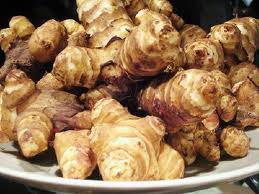
Topinambur and Turkey sex


No, don't let the title mislead you, this will not be a poultry porn post featuring certain knobbly roots...just I had planned the whole post this week around my newfound love for Jerusalem Artichokes (topinambur), (and that will come in following paragraphs), but the noble veg was bumped off the priority register by a fresh a miracle that happened only yesterday...

The turkeys had SEX!  and again today!  And maybe again tomorrow!  And for about a week now, we have been getting one turkey egg per day...that means that one of the turkey hens is laying, and one of them is getting laid.... Not sure if they are the same hen, (because only one of the hens has submitted so far) but just in case, Thanksgiving, Christmas and Easter have all three earned a stay of execution.  If we can get them to reproduce, they will be worth feeding over the winter, and we will be able to produce our own turkeys year round instead of buying the chicks (turkey chicks cost about 10 euros each!)

According to Barbara Kingsolver (in "Animal, Vegetable, Miracle") turkey sex is supremely rare.  I think that may be just american turkeys, but nonetheless, even here the norm is for artificial insemination and mechanical incubation, which means the animals themselves just don't know how to 'do it'.  The big heavy meat birds actually physically can't do it, but our second round of turkeys are a local rustic breed and they seem to be managing just fine.  In fact so long as Natalina, the original turkey hen (a commercial meat hybrid) was around, nothing was happening.  She was too big for the cock and she didn't make eggs, even though she was 3 months older than the other hens.  Now Natalina is in the freezer, and they're getting jiggy every day!  Takes them about an hour too, to get it all over and done with, from dancing and displays to the actual deed.  Funny in comparison with the rooster, who takes never more than 2 seconds...hop on, hop off, hop on, hop off (karate kid cock!)   The video below Gab took to show to some geese experts, trying to figure out if our geese are boys or girls (more poultry sex, hmmm), but there are some nice shots of the turkey cock in the background showing off his stuff...


So now for the originally planned post -- Jerusalem artichokes are THE MOST AWESOME VEGETABLE ever!  We started harvesting them last week, and I started researching what they are and what to do with them...OK, a vegetable that

1) Grows all by itself, in just about every climate, produces up to 5kg of edible root per plant with no work at all, and the biggest challenge is keeping it to its appointed space because it will take over if you let it (now I know what it looks like, I see it wild everywhere)
2) is the highest vegetable source of iron known, and is also full of other essential vitamins an minerals
3) tastes more or less like potatoes, and is filling like a carb, can be roasted, mashed, fried, but also eaten raw and yet has a fraction of the calories of potatoes and other carbs.
4) has been implicated in prevention of diabetes, and directed towards even a cure -- it is a carb, but its sugar is in fructose and Inulin instead of starch, and humans can't digest inulin -- so you get carb satisfaction without any impact on blood sugar and without carb calories.  In fact, it also makes a lovely flour when dried and ground (made bread with it this week, delicious!)
5) IS DELICIOUS

What more can you ask for???  I just love delicious calories that come naturally and wildly, without too much intervention, and the Jerusalem artichoke is just that.  Its actually not an artichoke, and has nothing to do with Jerusalem -- its a type of sunflower, (girasole, and 'jerusalem' comes from that)  and you eat the roots.  Peeled, they can be eaten in any way you eat potatoes.  Long term and winter storage is best just in the ground, dig 'em up when you want to eat them, and they live right through the deepest freeze, so those you don't dig up make next year's crop.  For the deep freeze of winter, they can keep in boxes of damp sand in the cellar, or I read of one gardener that put them in buckets of mud by the back door -- still freezes, but easy to get through.

One warning though...all that undigestible inulin makes for some pretty world class farting!  So add to my list of positives about this veg 6) keeps you entertained for hours with family fart-offs! ("pull my finger Nina!") But don't eat lots before a long road trip...!

Sunday, October 16, 2011

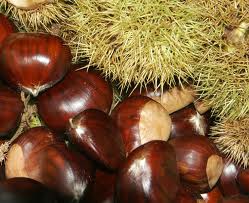
Everything you ever wanted to know about Chestnuts, and probably a bit more

Chestnuts Chestnuts Chestnuts Chestnuts Chestnuts...for the next few weeks, that's all I'll be seeing in my waking hours and in my dreams...

Chestnuts are an awesome food, though -- they are roughly the nutritional equal to rice (so treat as a carb, not a nut!), and can provide a carbohydrate staple in the diet.  Different from other carbs, though, is that they grow on trees, renewed every year without any special care or special demands on the soil.

All our other carbs, rice, annual grains, corn, soya, are extremely demanding on the environment in so many ways -- they take loads of irrigating, which means salination of the soil as well as draining and ruination of wetlands. They take loads of nutrients from the soil, which means loads of petrolium  based fertilizers in order to use the same fields year after year  -- and without that petrolium based fertilizer, all those beautiful amber waves of grain are absolutely sterile (yeah, bio fuel my ass...hate to break it to the bio fuel believers out there, but the biomass doesn't grow in sufficient quantity without the petrolium based fertilisers...bit of a catch 22 there) They take loads of heavy machinery (also oil dependant) to sow, to harvest, and to process.  Grains on a large scale are simply not sustainable without oil, and as it starts to run out, we will have to learn to do with fewer annual grains and standard carbs in our diet.

But not so for chestnuts.  They just fall from the trees.  You can prune them a bit if you want, and it doesn't hurt to give them a bit of manure around the base, but whether you do or not, they will still make lots of yummy carbolicious fruit, which makes a flour usable like wheat flour (though the bread is not so nice and fluffy).  The problem with chestnuts is in the processing.  They are super yummy and delicious, but their shell and skin is a total PITA to remove. (Mind you, its not a piece of cake to thresh, separate and grind wheat by hand either, and so!)

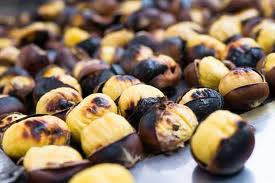
I've been experimenting and researching all over the internet for other people's experiences and advice, and have tried about 16 million different methods so far (well, maybe 5 or 6...) and still, it takes at least an hour per kilo to prepare and shell chestnuts.  The best method I've found so far is to make a good long cut across the fat belly of the chestnut, then roast in a super hot oven for about 15-20 minutes.  The outside shell gets crackly and peels off easily. The inside skin, if not removed with the shell, comes off easily if you rub and roll the nut around between your hands.  To get just the pulp, rather than the full chestnuts, out its easiest to boil them for a good 40 minutes, without any precuts in the skin, and with a good dollop of oil in the water, then use the sharp tip of a carrot or potato peeler to breach the skin and swirl around/scrape out the pulp.  If you want the chestnuts free, whole, and uncooked (like for making Marrons Glacées), make a cut horizontally all the way around the chestnut, then steam for about 15 minutes.  Still a major pain in the butt, though!

Recipe for Chestnut Pudding: Made this with the first batch, and it is oh oh oh so yummy...
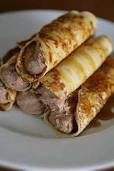
boil 500g of chestnut puree (boil chestnuts, squeeze out the pulp with the carrot peeler, squish any bigger pieces) in 500g of milk.  When it is good and pudding/porridge consistency (about 10-15 minutes i guess), take off the fire and add 150g of icing sugar, a sprinkle of cinnamon and a sprinkle of nutmeg.  Serve warm as a pudding, or save in a jar in the fridge to eat as is or use for a doughnut or crepe filling.

Today was another very productive day -- the inventory of the day is: 3kg of chestnuts roasted peeled and in the freezer for addition to winter soups and such, 5 apple pies (4 in the freezer and 1 on the table), 2 loaves of bread, one big batch of pumpkin soup, half for the table half for the freezer, and a bunch of meatballs...was almost too pooped to come and write the blog, but i figured that binning the first sunday after promising to write every sunday was just too pathetic, so found my second wind and here I am!

Monday, October 10, 2011

The work of the farmer's wife

So Gab spends the day out hoeing and raking and weeding and digging and chopping and sowing and cutting and picking and pruning etc etc etc.  But when his work is done, mine is just beginning.  Its my job to cook and stew and jam and pack and boil and sterilize and dehydrate and blanch and freeze and and and...And I Love It!  Really, I do!  I was worried it would be overwhelming, too much to do and all within a limited timeframe because otherwise everything rots and all Gab's work will have been for nought.  But its not overwhelming, its actually very relaxing and calming.  There's tons to do and the only way to get through it is to do it, so its very zen in that way -- just go with the flow, pick those beans and pod those peas and skin those tomatoes until there are none left to do.  Its even more fun with company, and I really think we have lost something grand when we stopped sitting on the front porch with all the neighbours gossiping and shelling peas.

Anyway, so here is a quick run down of all the cooking and putting away I've done over the last few months with links to the best recipes I've discovered in the process...in order of appearance...

First came the cherries.  About 10kg of black cherries was made into abou 10 jars of jam and 2 pies.  Then 40kgs of sour cherries was made into 10 traditional lattice cherry pies (in the freezer)...the BEST cherry pie recipe ever: http://www.epicurious.com/recipes/food/views/Classic-Sour-Cherry-Pie-with-Lattice-Crust-242514, and I mean EVER...even better than the cherry pah from the Matawa café..., then I burned about 30 jars of cherry jam.  Damn Damn Damn...took about 6 hours to pit the cherries for that batch of jam (even with my awesome cherry pitter machine: http://www.chefscatalog.com/product/93600-leifheit-cherry-stoner.aspx), and I BURNED it.  URG!!!  And the last 15kg went into a fermentation vat, and produced approximately 12 litres of sour cherry grappa...mmmmmmmmm

Then came the peas and beans -- peas were not nearly enough, and we ate them as they arrived, and we know to plant more next year and to treat them differently as well, because they should have been much more productive.  But the beans though...they started giving in June, and still haven't really stopped yet.  I have about 5 big jars of spicy pickled beans put away (bring vinegar to boil with a spice bag with cinnamon stick, mustard seeds, corriander seeds, black pepper corns, and some spicy chillis, blanch beans in vinegar, jar up, cover with boiling vinegar, and seal), and about 20kg of blanched green beans in the freezer for use throughout the winter.  And we eat fresh beans at least three times a week...yum yum yum....

The borlotti we pulled up when they were full and hung the plants to dry, and then once dry, shelled them all, and we have about 3kg of dried borlottis away in glass jars -- that was ALOT of work for not many calories. But they are gooood calories, though, and Mia helped me -- we had fun picking away at them all day long.

Then the along came the plums...from one little teensy Santa Rosa tree we got about 90kg of plums. They were quite literally coming out of my ears.  I made about 60 jars of plum jam, in three different batches and variations, sliced and froze about 5kg, and hot packed whole another 20 jars.  And we still had flats upon crates upon boxes of plums...time to visit the neighbours!  Everybody got the gift of plums this year...Then about 2 weeks after the santa rosa's finished, the damsons came.  With these I made another 20 some jars of jam, some with fresh ginger, and about 18 jars of a FANTASTIC plum ketchup: http://www.food.com/recipe/plum-ketchup-64525 -- excellent as a barbecue sauce, a marinade, and a stir frying sauce, as well as just as ketchup.

And then peppers -- the sweet lombards are pickled and away in jars together with the spicy ones -- I didn't know they were different at the first fruiting, and put them in together...eee, spicy!!  And then loads chopped up in the freezer, and loads pan fried for dinner.  There are about 5kg of classic bell peppers, green and red, in chunks in the freezer waiting for winter stir fries.

In the midst of all this, the herbs are coming and going, so we have bags and bags of parsley, mint, sage, basil and dill chopped and frozen, ready to use.  The basil has come to harvest strength five times this summer, each time we've taken about 2 or 3 crates full -- each crate makes about 1.5kg of pesto (and about 100g of pesto will do for pasta for 4 or 5 people), so I have about 10kg of pesto in the freezer along with tons of just plain chopped basil ready to use, and we gave tons of both basil and parsely to Angelo and his restaurant.  My fave is pesto with walnuts instead of pine nuts.mmmmm

Tomatoes went through 4 proper harvests, but the beefeaters and cherries didn't do so great.  The first beefeater crop was nice, but it didn't do anything afterwards. The Principe borghese were our king crop of tomatoes, and with these (about 10-15kg per harvest) I have put away about 30litres of tomato purée, about 10 litres of tomato sauce, about 8 bottles of whole canned cherry tomatoes, and about 12 bottles of tomato ketchup (super duper yummy -- it will actually run out soon because we go through about a bottle every 2 weeks, and when it does, I don't know how we'll go back to the store bought kind).  Next year we need more tomatoes, and bigger saucier ones.

And in the meantime, we are getting a really generous crop of aubergines (eggplants) which neither of us actually like very much, so what to do with them all?? First we gave away tons, then I learned an awesome recipe for chutney, and made an aubergine apple and fig chutney that is to die for.  Have about 8 jars of that.  Then I pickled a bunch with sweetened spicy vinegar, about 6 jars of that.  And the rest we made into soups and rattatouille to eat right away -- changed my mind about aubergines, and now I'm kind of sad they are almost finished.  I'll put the last of them away in the freezer so we can bring them out for soups and stews in the winter.

The zukes made TONS but we ate them ALL as tiny babies as soon as they were ready -- worried about the classic "too many zucchinis and nobody wants them" problem, we solved this by eating TONS of zucchini flowers, and loads of grilled and stir fried zuchinis picked when they were no bigger than 10cm.  Sweeeeeet.

Also overloaded with potatoes, from the earlies to the maincrops -- we've given away loads, eaten loads, and have about 40kg in the cellar and still another 2 or 3 rows still in the garden.  And that was after wild boards made off with about half the potato crop.  They made off with ALL of our sweet corn, so the potatoes should count themselves lucky.

Phewff -- its almost more work to talk about all the stuff we've harvested and put away than it was to do it in the first place...I'm getting kind of tired of this post, and I still haven't mentioned the figs (40 jars jam), the pumpkins (puree in freezer, pieces in freezer, and 13 pumpkins in dry storage), the apples (20 jars apple sauce, 4 crates in dry storage, 3 cakes in freezer, and chutney still to come), the pears (10 jars pear sauce, just like apple sauce), peaches (12 jars jam, 8kg pieces in freezer, 2 cobblers in freezer), blackberries...so much work to pick, so little yield...all in freezer...

And now the chestnuts begin...made chestnut jam last week and just the thought of it makes my knees weak...mmmm...but they are so HARD to peel and prep.  Hours and hours and hours of work for a kilo or two of pulp.  UGH.

OK, enough enough already...I'm tired, its lunchtime, and today there are another 5kg of chestnuts to go through and the apple chutney to get underway....

Inspired by Ken & Nicole Barker's blog (http://barkersfarm.wordpress.com) on their newly started organic farm experience, i am from here on going to be more regular and less exhaustive with the posts -- they are blogging every sunday, and I think that's a great idea!  So from now on, every sunday I'll try and post, whatever has happened that week!

Friday, April 15, 2011

Winter Work, Spring Work

Its been FOREVER since my last post, so sorry...but I have my excuses...fourth baby is on his way, due 11/11/11 (no, really!), and I've been laid out with first trimester nausea, tiredness, and general blah-ness.  In the 10th week now, and starting to move into the "superwoman" second trimester phase, when i will clean every corner, wash all the windows, iron everybody's underpants, and generally be full of energy and vim and vigour.

So what has been going on in the last two months?

Well, February and early March were full of winter work -- Gab has been up to the little farm every day, working at it full time and the late winter weeks he :

  • pruned the fruit trees, 
  • planted new ones (add to our inventory another 16 grape vines, 15 hazelnut trees, 2 walnut trees, a pomegranite tree, 6 blueberry bushes, and 6 current bushes, plus sage, rosemary, and rhubarb in the perennial beds), 
  • built a super duper mega chicken coop, and a separate little one for chicks, 
  • hauled about 6 tonnes of gravel to resurface the driveway and build the foundations for the coop
  • fixed and refinished some of the fencing
  • Built a support for housing the bee hives whenever they finally get here
  • Got the house hooked up to electricity and wired
  • did some terraforming around the spring, so we now have a pond for the ducks to play in
  • Cleared the wood of brambles and undergrowth and started building terraces along the steep hillside
  • chipped all the brambles and prunings to make mulch
  • hauled over 11 tons of prime seasoned organic manure (he's special friends with the organic cow farmer who shares his special personal reserve stock with Gab...he gives him the good shit) and spread it around the trees and over the terraces where the veggies will go.
And then the winter broke, and we went straight from winter into summer, with 3 weeks of 30 degree plus sunny weather (the recorded high on the little farm thermometer was 37 degrees -- what is this, Africa? geeze!) we had to get our butts in gear to get the ground plowed and the manure spread in and the rows prepared for the veggie garden.

I did a whole bunch of research and studying and planning and designing for the veggies, so that we would have manageable sections of veggies that were manageable for rotations and also companion planted (planted together with other plants that assist each other -- onions keep away bugs, and are good with almost every other plant.  Nasturtiums act as an Aphid trap, and are great with everything but especially tomatoes.  Beans work well with cabbages, fixing the nitrates that the cabbages eat up.  NOTHING with potatoes...they need to stay all by their lonesome. And turnips love to live under fruit trees, who'd a thunk it!).  So it was beautiful designed and quite complex...and we followed it for the first ten minutes before we got carried away and just started planting everything everywhere! 

And over the course of the next couple of weeks, we kept remembering other things we should have planted, and tilling more new beds...and now we have planted nigh on 500sqm of veggie garden...HOLY SMOKES.  I'm a bit scared of what's going to happen when all those plants start producing...but we'll take it one step at a time and see how it goes.  And excess can go to the local CSAs who have said they want to buy our produce, and if its still too much, well...it will be time to get pigs!  They'll take care of any leftovers, and make really yummy salame out of it too!

So now all the seeds are in, the seedling plants we started indoors are also down, and we are waiting patiently for it to rain.  We've watered a few times from the spring, with a diesel pump that takes the water from the spring and pumps it up to the terraces so we have a hose with running water, but it would be really nice if mother nature would do her part and let it rain already.  Its been about 4-5 weeks without rain, argh!

And on that note, I leave you with "RAIN IS A GOOD THING" -- was one of our favourites in Vancouver (I guess we figured if we kept repeating it, it might feel true...now and with a lovely irony, we really really mean it!!) : http://www.youtube.com/watch?v=4VKy69sE4VY

Monday, February 7, 2011

Fruit tree inventory...a moment of boasting,sorry!

we've done the full count of the fruit at the little farm and catalogued it for registering with the farmer's association, and I just can't resist a moment to be proud of our new place...

here's the inventory -- total number of trees is about 92, give or take because the chestnuts are just so many we didn't count them precisely.  The bold italic number is how many total trees per type, and the column of numbers to the right of that is the approximate age of each individual tree


TreeTotal no perestimated age of each tree


Apple, various types11201551520502010303015
pear, Various types52055510


Figs, various types82020202010111


Walnut81515203020301530


Plum, various types1015151050153015101010
peach2105


Cherry, various types750151550503030


Susine (plum cousin)55020302030


Nespolo (local fruit)115


Heritage Apples25050


Almond150


Marron Chestnut1100


Chestnut25(approximate number, there is a wood full of them, all varying ages)


Grapes615


Yummmmmm!!  Gab has been approached already by the heads of two different CSAs who want to buy our excess fruit...with all those trees, I'm thinking there will be quite a bit of excess!

We picked up the Ape today, and now have farmer wheels, woohoo!