Ho già raccontato di Peppino in un post precedente.
Qualche giorno fa viene a trovarmi e mi dice che un suo amico ha una costa piena di spini da ripulire. Gli ha chiesto di portare le sue pecore per svolgere il lavoro. Il buon Peppino suggerisce invece all'amico Geppe di impiegare le mie capre, perchè il "broc" ovvero la crescita del giovane bosco che sta crescendo là è roba per capre e non pecore, ed io sono a due passi, mentre le sue pecore sono in fondo alla via Canale, a 4km di distanza.
Guardo Peppino un po' interdetto: "Cosa mi frega di portarle a ripulire la boscaglia del Geppe, qui ci sono ettari di bosco in tutte le direzioni, non mi serve". Peppino mi dice di seguirlo e non preoccuparmi, che visto il posto capirò.
"Tu digli sempre di sì e stai zitto, lascia parlare me che quello è originale", mi ordina. Va bene, mi dico, non posso contraddirlo, andiamo a vedere.
Sono due o trecento metri di distanza da me, due passi. Passiamo per il bosco, una radura, poi un prato si apre davanti. Recintato, sarà un ettaro e mezzo. E in fondo c'è una bella baracchina in cui ripararsi quando piove. Ci sono due vasche da bagno, per l'acqua.
Il recinto necessita di qualche riparazione, ma tutto sommato è ancora passabile. Geppe ci teneva 50 pecore. "Stai zitto che te lo faccio prendere", mi dice Peppino.
In effetti il Geppe è ragionevole e amichevole, e in cinque minuti ci si accorda sull'uso che potrò fare del suo recinto, in pratica e' come fosse mio eccetto in settembre quando lui e il fratello sparano dal capanno, allora sara' meglio non tenerci le mie bestiole. Poi dovrò anche sfalciare il pezzo di prato e la piana. Caspita, penso, questo ha un sacco di posto a due passi da me e non se ne fa nulla, ed è disposto ad affidarmelo.
Dopo quelli che mi hanno appena affibbiato alle Piazze, eccone un altro.
Da qui è partita una riflessione su quello che (mi) sta succedendo in Canale: indipendentemente dalla proprietà dei terreni, essi vengono coltivati da chi può farlo, chi ne ha voglia, con o senza attrezzature. Quelle le mette chi le ha, io taglio, lui imballa, l'altro volta, il proprietario... boh. Tutto è a prestito. Nulla e' registrato, e' tutto sulla parola. E i lavori vengono assegnati su basi fiduciarie.
Fermi tutti.
La terra, qui, va a chi la lavora. Orpo! Roba zapatista, mi ricorda quando da bambino guardavo i film spaghetti western e in uno sulla rivoluzione messicana, sentii quello slogan, "la terra è di chi la lavora", una frase, un concetto rivoluzionario e socialista che m'è rimasto in testa fino ad oggi e che sicuramente mi ha influenzato!
E ce n'è ancora! Ci sono l'autorganizzazione del lavoro e la redistribuzione dei terreni, assegnati ancora sulla fiducia, da ciascuno secondo le proprie disponibilità, a ciascuno secondo le proprie necessità. Altro slogan, e anche questo è socialismo, anarcosocialismo. E non solo i terreni, adesso m'e' arrivato un fienile e una stalla, grossi, saranno 3-400mq di roba che posso usare cosi', se mi serve, finche' mi serve. Incredibile!
C'è, in Canal, addirittura l'isolamento sociale dei soggetti indesiderati (ladri). La comunità stessa che supera la necessità delle pene e della coercizione punitiva. Orpo. Ancora anarchia, ancora socialismo. Difatti, a Provaglio non ci sono forze dell'ordine.
Incredibile.
Socialismo reale a Provaglio Valsabbia. Anarchia.
Tutto vero e funzionante, davanti ai miei occhi, sotto al mio naso. In pieno occidente capitalista, Italia, 2012.
E per poco, quasi quasi, se non stavo attento, non me ne accorgevo.
C'è speranza per il mondo.
Allegria!
Monday, July 16, 2012


Friday, July 6, 2012
Make hay while the sun shines
What our animals eat is at the very foundation of our project -- it needs to be healthy, clean, sustainable, organic. And when they eat well, well then so do we! The quality of the goats' hay has a huge impact on both the quality and quantity of their milk production. So, of course, we can't just go to the farm shop and buy their hay-- round here the good hay is kept for the hay-makers animals, and only the crappy hay makes it to market. So its another thing that we have to learn how to make ourselves, and one that I had completely overlooked in our planning stages.
Making hay looks so easy, but there is a whole science around what types of plants to cultivate in the hay fields, when to cut them, and so on. And making hay in mountain fields is a far cry from the nice flat john deered hay fields you see lining the edges of the motorways. In the sloping and irregular mountain fields, the hay can only be cut and worked with small machines and hand tools. Only a push mower can get into the cracks and go up the slopes. The steeper slopes have to be hand cut with a scythe and hand turned with a rake.
To make hay you must 1) cut the right grass at the right time 2) turn it as it dries in the sun, so it dries nicely without losing its nutrients and 3) bale it up into manageable sized bales. 4)Gather and store it appropriately so it lasts through the winter. It really does sound easy...
The baling is entirely reliant on technology -- if the baler works then its OK, if it fails then woe woe woe! Yes, our baler has been a bit uppity, but that is completely another story -- that will be the next post i think! The last time around, it took Gab 4 or was it 5 days to bale all the hay, because of baler failure. Under normal circumstances, it would take about 1-2 days.
And last but not least, heave ho over 100 x 40kg baby bales into the pick up which fits about 12 at a time, truck them up to the hay barn (which we don't have yet, so they are in a gazebo for the moment!), unload them and go back for more. Repeat until the circa 125 bales are loaded and put away. A job that gets done one trip a day over the course of 10 days or more.
So how much frickin' work is that??? Holy smokes! 2 days plus 2 days plus 2-4 days plus 1-2 days...7-10 days work. OK, we can handle that (well, Gab can...I'm right glad that's his job and he's happy with it!!), and just one cutting is enough for our animals, and the other cuttings throughout the year we can sell at a pretty good price.
EXCEPT that if it rains during the process, just once is enough, then ALL the hay is ruined. It can only be used for animal bedding or compost. And the rotten thing is, even though you know the hay is worthless on the ground, you still have to turn it, bale it, pick it up, otherwise the field beneath will be ruined and you can't make more hay next time. That's what happened this June -- 11 days of work for crappy worthless mouldy hay because it rained at just the wrong time, contrary to all the weather predictions. Aaaaaaaaaaargh! That is such a classic farmer's frustration. Days and days and days of work, all up the spout because of a glitch in the weather. And you don't want to know what 11 days of neglect does to a big veggie garden...
So, my dears, it really is as they say...MAKE HAY WHILE THE SUN SHINES! Or Else!
 |
| The mountain tractor, finished cutting |
 |
| Field of hay waiting to be baled |
Our hayfields are all in the mountains around us, so have to be cut with Gab's hand pushed tractor. It takes gab about 2 days just to cut the hay in the fields that have been entrusted to him (we cut our neighbours hay, they don't need it but it needs to be done so it works out for everyone). For the turning, there is a turning attachment on the same hand pushed tractor. It takes another full day to turn and dry if there is full hot sun. If its cloudy or dewy from too cool evenings, it can take two turnings and thus two days.
 |
| ahhh, lovely finished bales waiting pick up |
And last but not least, heave ho over 100 x 40kg baby bales into the pick up which fits about 12 at a time, truck them up to the hay barn (which we don't have yet, so they are in a gazebo for the moment!), unload them and go back for more. Repeat until the circa 125 bales are loaded and put away. A job that gets done one trip a day over the course of 10 days or more.
So how much frickin' work is that??? Holy smokes! 2 days plus 2 days plus 2-4 days plus 1-2 days...7-10 days work. OK, we can handle that (well, Gab can...I'm right glad that's his job and he's happy with it!!), and just one cutting is enough for our animals, and the other cuttings throughout the year we can sell at a pretty good price.
EXCEPT that if it rains during the process, just once is enough, then ALL the hay is ruined. It can only be used for animal bedding or compost. And the rotten thing is, even though you know the hay is worthless on the ground, you still have to turn it, bale it, pick it up, otherwise the field beneath will be ruined and you can't make more hay next time. That's what happened this June -- 11 days of work for crappy worthless mouldy hay because it rained at just the wrong time, contrary to all the weather predictions. Aaaaaaaaaaargh! That is such a classic farmer's frustration. Days and days and days of work, all up the spout because of a glitch in the weather. And you don't want to know what 11 days of neglect does to a big veggie garden...
So, my dears, it really is as they say...MAKE HAY WHILE THE SUN SHINES! Or Else!
 |
| Mia takes a hay bath with zia Sabri |
Thursday, July 5, 2012
Breaking Bee Records
It would be awesome if our bees were breaking honey production records, or quality records, or other such positive and exciting things that the title may have led you to believe...but alas, the bee record that i broke last week was the "most stings recorded in a single attack".
That's the kind of record I'm not so anxious to break again!
It was my first time out to actually actively help with the bees. Both Gab and i were fully suited and booted -- full body suit, mask tucked in, gloves, boots, the works. We were aiming to catch a really big swarm that had got away that morning and was settling into a high branch on a cherry tree.
We didn't want to cut the branch off, because it is a major part of the cherry's production. But it was too high to just grab and pull down. So we improvised...Gab had me hold the hive on top of my head, and he climbed up the tree to shake the swarm off the branch and into the hive...yes, the one on top of my head. Gosh, that really does sound stupid, now that its all written out in black and white, doesn't it? But at the time it made perfect sense. Swarms are docile when they are swarming, and Gab had done may similar such manoeuvers with other swarms.
Only thing is, he wasn't perfectly aligned when he shook the branch...and the swarm MISSED the hive and went THUMP all the way to the ground right beside me. And swarming or not, no bee is docile when its been thumped to the ground like that! Let alone about 10.000 bees thumped to the ground all at once.
I got 23 stings that made it through all the protections, and the suit was full of stingers that didn't make it through, more than a hundred stingers in the suit all over. Actually, i was most surprised at the fact that the stings don't really hurt that much -- maybe because they were through the suit, and therefore not as much venom got through. The worst was the itch two days later!
Anyway, its all good -- bee venom is very good for you...in small doses!! And Gab caught the swarm the next day all by himself, using a ladder to hold the hive instead of his wife's head. Much safer that way!
We're well into summer now, so lots is happening and there's no time to write about it, but in the next few days i'm planning to write a number of smaller posts trying to catch up on everything overall...thanks to Kaitlyn for the nagging, otherwise i'd just get carried away in the day to day and forget completely to blog it!
Monday, June 11, 2012
Le gratificazioni dell'Homo Agricolus - grazie per la fiducia accordata
Alcuni esercizi commerciali scrivono sui sacchetti "grazie per la fiducia accordata". Ipocriti. A loro interessa il mio acquisto, con la mia fiducia non si pagano i fornitori.
C'è un pastore, in fondo alla via, si chiama Peppino ed ha 50 pecore.
Il Peppino da sempre alleva vacche, pecore e capre e sfalcia e vende fieno che taglia nei suoi tanti prati col trattore e la falciatrice, un lavoro pesante malgrado l'età vada ormai verso gli ottanta.
Sempre per non perdere l'abitudine e tenersi in forma, fa pure il boscaiolo, davanti a casa sua ci sono enormi cataste di legna da tagliare, spaccare, impilare, caricare sul trattore e consegnare.
Col sole, la pioggia, con la neve. Lui è sempre fuori con le sue pecore e suoi cani.
Peppino è una persona per bene, è rispettato e sa farsi rispettare, il suo giudizio su un animale -o su una persona- è pesante, a Sabbio Sopra, quanto quello di una corte di giustizia. Suoi, o dei suoi discendenti e familiari, sono parte dei prati lungo il Canale e nelle Piazze. Li sfalcia lui, anche quelli non di sua proprietà.
Peppino è una persona dalla battuta pronta, il suo sarcasmo è tagliente, anche caustico, ma ogni volta divertente. Sa farsi ascoltare anche quando è irriverente. E' uno giusto.
Certo che lo stimo. E gli porto uno scherzoso, ma sinceramente ossequioso rispetto.
Da quando lavoro in Canale si fa vedere regolarmente, mi studia, chiede cosa faccio, commenta le mie tecniche e lavorazioni che, apprese per lo più sui libri, spesso si discostano dal modo di lavorare che lui conosce meglio, quello tradizionale del posto. Mi piace confrontare con lui pregi e difetti dei vari sistemi e, per rispetto alla conoscenza tradizionale e per uno strano senso del dovere, chiedo, mi informo, mi sforzo di imparare tutto quello che può e vuole insegnare, sulla sfalciatura del fieno, il bosco, le erbe e le piante buone e quelle cattive, l'allevamento, i cani, il pascolo.
Cerco di assorbire il più possibile e ne nascono spesso discussioni stimolanti, anche perchè nonostante l'età si dimostra tutt'altro che scettico o chiuso verso le mie stranezze. Spesso mi loda, e mi piace sorprenderlo con prodotti "esotici" che non conosce. I Topinambur gli sono piaciuti al punto che se ne è fatti dare qualche manciata da piantare questa primavera. La moglie ne va matta, mi dice.
Qualche tempo fa, dopo avermi visitato e ispezionato puntigliosamente le capre, facendomi i complimenti per la scelta, mi giunge voce dal paese che il Peppino dice "in giro" che le mie capre sono tra le più belle che ha mai visto e che, a tenerle bene come le sto tenendo, "le farà bel fes", ovvero mi daranno soddisfazioni. Orbene, mi sono detto, la prima grande soddisfazione me l'ha data proprio lui, la sua approvazione -pubblica, per di più- conta per me più della medaglia alla fiera nazionale. E mi verrebbe da dire che le lodi da sperticare sarebbero quelle degli allevatori che le hanno selezionate e tirate grandi a sufficienza per portarle da me. Ma tant'è, il riconoscimento, almeno per il lavoro che sto facendo, è arrivato e me lo prendo con gusto.
Prima gratificazione.
Seconda: lo scorso anno, mentre sfalcio un prato vicino ai suoi, mi dice che forse per l'anno prossimo mi lascia tagliare uno dei suoi pezzi, visto che mi serve il fieno e visto che sta diventando faticoso per lui da fare con la falciatrice, lui preferirebbe fare solo i pezzi col trattore. Mi sono detto, ad avere la sua grinta, mi aspettano almeno 40 anni di sfalciature in piedi con la BCS. Non so se sarò in grado di trovare una potenza così in me, ci proverò. Se non altro per sfida. Se ci riesce lui, diamine, devo farcela anche io. Tanto non è serio, mi dicevo, figuriamoci se me lo affida davvero. Sta scherzando come al solito, mi provoca per vedere la reazione. Ovviamente accetto con finto entusiasmo. Non posso mica dirgli di no.
Passa un anno e si ricomincia con il fieno, mi ferma mentre passo e mi molla la bomba, "dobbiamo andare alle Piazze che ti mostro i confini".
Ostia.
Era tutto vero.
Andiamo.
Sono emozionato, mi rendo conto che lui, l'ultimo pastore di Sabbio Sopra, l'autorità morale ed etica più alta del Canale, ha chiesto a me, io povero cretino appena arrivato, di sfalciare i suoi prati.
Poteva darli a chiunque, ci sono una mezza dozzina di agricoltori e allevatori che ne hanno bisogno nei paraggi, mica solo io. No, tocca a me. Forse, mi dico, mi vuole solo mettere alla prova. Il prato è molto grande, di certo avrò più fieno di quello che mi serve, ne avrò da vendere.
Eppure non ero il solo ad essere emozionato, credo che anche lui avvertisse un po' la solennità del momento, si comportava stranamente.
Non lo avevo mai visto così severo, serio e preciso. Mi impartiva gli ordini di lavorazione come un caporale con le reclute, "si parte di qua, si volta di là, si infila da questa parte, non farlo là" e via così. Nemmeno una battuta, niente. Finito il giro, si fa riportare a casa e sparisce dentro, niente ciao.
Avere in carico il prato del Peppino è più che un lavoro, è un onore. Una gratificazione personale importante perchè materializza una fiducia data, la fiducia che qualcosa, tra quello che passiamo la vita a fare, grazie a qualcuno prosegue alla faccia dello spettro dell'abbandono, visibile ovunque, nelle terre, nei mestieri, nelle parole. E quel qualcuno sono io. Segare il suo prato è una medaglia che porto sul petto quando incrocio gli altri contadini che sfalciano attorno. C'è scritto "ci sono".
Tutta questa fiducia è inattesa e forse immeritata, certamente sono inadeguato allo scopo, o almeno così mi sento. Non ho nemmeno il posto per tenere via tutto questo fieno. E non va bene per le mie caprette, l'ho venduto a uno che lo darà ai torelli, per loro è perfetto. Dovrò lavorare come un mulo per due lire. Pazienza, si fa lo stesso. E non basta, perchè una volta fatto tutto il terreno assegnato, "se ne avrai ancora voglia", di prato ce n'è ancora il doppio, il triplo, ce n'è a sufficienza per un medio allevamento.
Sono lusingato, onorato, un po' impaurito dalla mole di lavoro e terrorizzato all'idea di deluderlo.
Domani vado a trovarlo con un salame, una boccia di vino, e glielo dico.
Ci provo, Peppino.
Grazie per la fiducia accordata.
Monday, May 7, 2012
The Great Escape
Gab went off on a field trip with Mia yesterday, and left me with the other kids. 14 hoofed ones and 3 with little human toesies. (note, all pics are from a few days ago, when they are happy in their pasture...nobody took any pictoral evidence of yesterday's shenanigans...thank goodness!)
 I was given what seemed to be adequate instructions before he left: "feed them 1/2 bucket of kibble in the morning and 8 litres of milk in the evening, 6 in the bucket with teats and 2 in the 1 litre bottles with baby nipples...oh! Be careful opening the door when you take them the milk, but if some get out, don't worry, they'll come back in when they see their sisters drinking..."
In actuality, it wasn't nearly that simple. First problem which bloody bucket??? There was no bucket by the feed. There were a couple of buckets outside the barn, but they were near the mucking out brooms so I figured they were cleaning not feeding buckets. Aha, but there's a bucket in the sink, near the milk bucket. Must be that one. But 1/2 of it doesn't seem the 2kg he said it should be...well, I'll just give 'em a bit more, if its just a bit too much it'll be like Christmas...So that was the morning feed.
 Afternoon feed, and here comes the milk, heated up faithfully to 41 degrees then poured into the bucket. AAAAAG! The nipples leak everywhere, mess mess mess! Quick, make the bottles and get up there to them before it empties out on the floor. AAAAAG the nipples don't fit on the bottles, I must have the wrong bottles. try them all, quick!! Oh, here's ONE where it fits, but only one. Oh well, they'll have a bottle less tonight. It'll be just like the diet that starts on boxing day!
OK, holding a 6 litre leaking bucket in one hand and a 1 litre slippery dripping bottle in the other...how the Bloody hell do I open the door "carefully". Well, what would you do? Slowly...pushing carefully...thinking to push in thee moment it is open a big enough crack...of course, the moment the crack is big enough they all start pushing, butting and leaping all over me, and I can't get it closed. AAAAAG!! Run run to the milk bucket post to not spill the milk, not worrying about a couple that got out 'cause, well, i was told not to worry, right?
 So, feeding them the milk and only 8 of them are still interested in the milk. The other 6 have all escaped and are jumping in their hay in their manger from the other side. But they are just right here by the barn, and I'm not worried. Finished the milk, I go out to push them back in the barn...but i can't hold open the door and chase the goats in at the same time. I call for Nina. I call again for Nina. I SCREAM for Nina. I SCREAM BLOODY MURDER for Nina. Nothing.
OoooooKay, i can latch open the door, and thus chase these deviants in and not worry about the door. Smart, huh?... 2 minutes later, all 14 goats were in the veggie garden feasting on the fig and the plums and the itty bitty baby fava beans. AAAAAAAAAAAAAAAAAAAGGGGGGGG!
 It had been raining and thundering on and off all day, so they hadn't been out to pasture at all, just hanging out in their little coral, and these goats had ABSOLUTELY no intention of coming home right away. Especially not with baby beans to munch on. I run here, they run there. I run there, they run here. Up the hill, down the hill, half up, half down...and all variety of permutations. (aaand when they were up they were up, and when they were down they were down, and when they were only halfway up...where's the Duke when you need him???)
I call again for Nina. I SCREAM for Nina. I SCREAM BLOODY MURDER for Nina. Nothing. I give up, leave them to the hazel at the edge of the woods which they seem to be enjoying and go into the house screaming my ass off for Nina...in front of the TV with volume so loud nothing else is registering. She puts Nesto in his car seat and we charge raffi with entertaining him while we chase the goats back in...it'll only take a minute, right?
 Riiiiiigggght. I try and lead them with handfuls of feed while nina chases them from behind, but they are absolutely NOT having it. They are all bunched up against their electric fence, but on the wrong side...brainwave...I turn of the fence, pick up the picks and lay it down so they can just be chased to the other side, right? Riiiiigggght. That was SUCH a bad idea. They of course know that the fence "bites" so won't go, but have been made curious enough by the attempt that I risk having taught them how to escape whenever they want to now!
Oh look, here's Raffi "mummy mummy Nesto fell out of his chair" Ignore the goats, go flying back to the house, put nesto back in the car seat AND STRAP HIM IN THIS TIME...and then back to the goats and the downed fence.
So, get the fence back up, and I'm starting to panic now -- they won't run away, but if they keep eating all this wet rich green after a whole day indoors and after having already had their supper and extra feed rations, they all risk bloating up until they literally explode. Bloat is perhaps the most common end for a goat, and the one we have to be most afraid of. So now i'm thinking "if i don't get them in in the next 15 or 20 minutes, they are going to start bloating". And if that weren't enough, they all wanted to be around the beehives, there is some lovely hazel just behing and lovely lavender in front.... Just one hive knocked over, and we're all dead, dammit!
Right, face the problem right in the eyes and take the most direct action. I start to physically lift and manhandle them back into the barn, one by one. 20kg of kicking pissed off goat down the hill through the slippery mud and into the barn. Back up the hill. Back down with another wet smelly muddy goat kicking and bucking. Back up the hill. Repeat...by the time half of them were in, I was completely bagged. Luckily the others started to feel the loss of their companions and were more amenable. Nina thought she would put a rope on them and lead them in...that didn't work...
 And FINALLY I did what I should have done from the beginning...started to chase them away from the barn, but towards the road they always take to go between barn and pastures. As soon as they were on the road they knew, through the back woods, then they started trotting along happily in the direction i wanted them to go, wrap around and back to the corral. Nina did a great job chasing them, and then got completely tangled in a thorn bush just as they were on the lip of the gate to their corral fence, so instead of going in, they went over to the woods on the other side. But it was a quick matter to get them back on the road and then back into the corral from there. And as soon as they were back inside their corral fence, then and only then did the damn dog figure out we were trying to get them home and not just messing around with them (up till now she just chased them willy nilly, more problem than help). So, once they were already caught, then Heidi remembered she's a bloody shepherd, and did a marvelous job of taking them to the barn.
Ahhhhh...OK, now we can laugh. Nina said "DAMMIT I HATE GOATS", but she did a great job helping, and should take her thorny wounds as marks of pride!
 I was given what seemed to be adequate instructions before he left: "feed them 1/2 bucket of kibble in the morning and 8 litres of milk in the evening, 6 in the bucket with teats and 2 in the 1 litre bottles with baby nipples...oh! Be careful opening the door when you take them the milk, but if some get out, don't worry, they'll come back in when they see their sisters drinking..."
In actuality, it wasn't nearly that simple. First problem which bloody bucket??? There was no bucket by the feed. There were a couple of buckets outside the barn, but they were near the mucking out brooms so I figured they were cleaning not feeding buckets. Aha, but there's a bucket in the sink, near the milk bucket. Must be that one. But 1/2 of it doesn't seem the 2kg he said it should be...well, I'll just give 'em a bit more, if its just a bit too much it'll be like Christmas...So that was the morning feed.
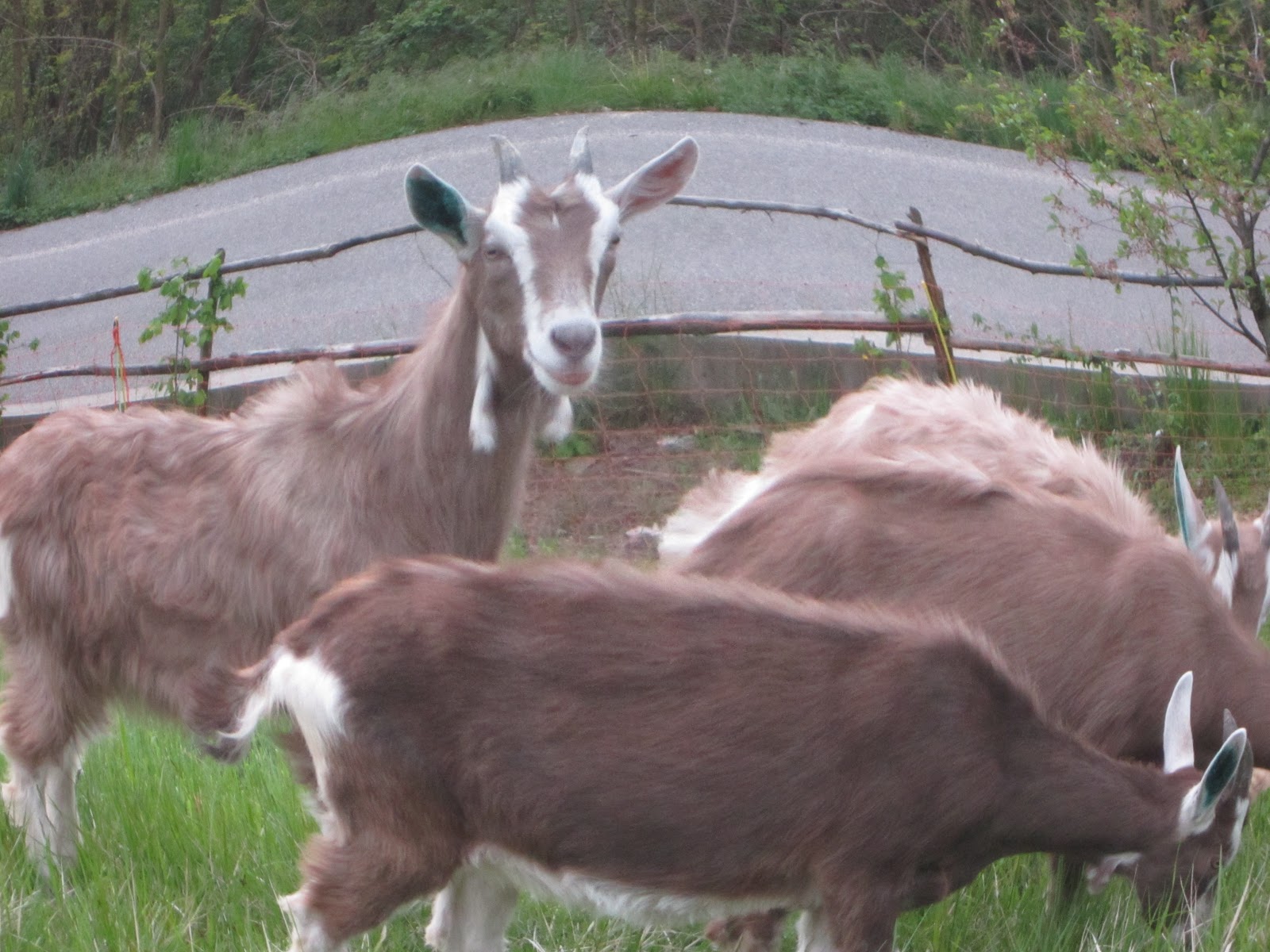 Afternoon feed, and here comes the milk, heated up faithfully to 41 degrees then poured into the bucket. AAAAAG! The nipples leak everywhere, mess mess mess! Quick, make the bottles and get up there to them before it empties out on the floor. AAAAAG the nipples don't fit on the bottles, I must have the wrong bottles. try them all, quick!! Oh, here's ONE where it fits, but only one. Oh well, they'll have a bottle less tonight. It'll be just like the diet that starts on boxing day!
OK, holding a 6 litre leaking bucket in one hand and a 1 litre slippery dripping bottle in the other...how the Bloody hell do I open the door "carefully". Well, what would you do? Slowly...pushing carefully...thinking to push in thee moment it is open a big enough crack...of course, the moment the crack is big enough they all start pushing, butting and leaping all over me, and I can't get it closed. AAAAAG!! Run run to the milk bucket post to not spill the milk, not worrying about a couple that got out 'cause, well, i was told not to worry, right?
 So, feeding them the milk and only 8 of them are still interested in the milk. The other 6 have all escaped and are jumping in their hay in their manger from the other side. But they are just right here by the barn, and I'm not worried. Finished the milk, I go out to push them back in the barn...but i can't hold open the door and chase the goats in at the same time. I call for Nina. I call again for Nina. I SCREAM for Nina. I SCREAM BLOODY MURDER for Nina. Nothing.
OoooooKay, i can latch open the door, and thus chase these deviants in and not worry about the door. Smart, huh?... 2 minutes later, all 14 goats were in the veggie garden feasting on the fig and the plums and the itty bitty baby fava beans. AAAAAAAAAAAAAAAAAAAGGGGGGGG!
 It had been raining and thundering on and off all day, so they hadn't been out to pasture at all, just hanging out in their little coral, and these goats had ABSOLUTELY no intention of coming home right away. Especially not with baby beans to munch on. I run here, they run there. I run there, they run here. Up the hill, down the hill, half up, half down...and all variety of permutations. (aaand when they were up they were up, and when they were down they were down, and when they were only halfway up...where's the Duke when you need him???)
I call again for Nina. I SCREAM for Nina. I SCREAM BLOODY MURDER for Nina. Nothing. I give up, leave them to the hazel at the edge of the woods which they seem to be enjoying and go into the house screaming my ass off for Nina...in front of the TV with volume so loud nothing else is registering. She puts Nesto in his car seat and we charge raffi with entertaining him while we chase the goats back in...it'll only take a minute, right?
 Riiiiiigggght. I try and lead them with handfuls of feed while nina chases them from behind, but they are absolutely NOT having it. They are all bunched up against their electric fence, but on the wrong side...brainwave...I turn of the fence, pick up the picks and lay it down so they can just be chased to the other side, right? Riiiiigggght. That was SUCH a bad idea. They of course know that the fence "bites" so won't go, but have been made curious enough by the attempt that I risk having taught them how to escape whenever they want to now!
Oh look, here's Raffi "mummy mummy Nesto fell out of his chair" Ignore the goats, go flying back to the house, put nesto back in the car seat AND STRAP HIM IN THIS TIME...and then back to the goats and the downed fence.
So, get the fence back up, and I'm starting to panic now -- they won't run away, but if they keep eating all this wet rich green after a whole day indoors and after having already had their supper and extra feed rations, they all risk bloating up until they literally explode. Bloat is perhaps the most common end for a goat, and the one we have to be most afraid of. So now i'm thinking "if i don't get them in in the next 15 or 20 minutes, they are going to start bloating". And if that weren't enough, they all wanted to be around the beehives, there is some lovely hazel just behing and lovely lavender in front.... Just one hive knocked over, and we're all dead, dammit!
Right, face the problem right in the eyes and take the most direct action. I start to physically lift and manhandle them back into the barn, one by one. 20kg of kicking pissed off goat down the hill through the slippery mud and into the barn. Back up the hill. Back down with another wet smelly muddy goat kicking and bucking. Back up the hill. Repeat...by the time half of them were in, I was completely bagged. Luckily the others started to feel the loss of their companions and were more amenable. Nina thought she would put a rope on them and lead them in...that didn't work...
 And FINALLY I did what I should have done from the beginning...started to chase them away from the barn, but towards the road they always take to go between barn and pastures. As soon as they were on the road they knew, through the back woods, then they started trotting along happily in the direction i wanted them to go, wrap around and back to the corral. Nina did a great job chasing them, and then got completely tangled in a thorn bush just as they were on the lip of the gate to their corral fence, so instead of going in, they went over to the woods on the other side. But it was a quick matter to get them back on the road and then back into the corral from there. And as soon as they were back inside their corral fence, then and only then did the damn dog figure out we were trying to get them home and not just messing around with them (up till now she just chased them willy nilly, more problem than help). So, once they were already caught, then Heidi remembered she's a bloody shepherd, and did a marvelous job of taking them to the barn.
Ahhhhh...OK, now we can laugh. Nina said "DAMMIT I HATE GOATS", but she did a great job helping, and should take her thorny wounds as marks of pride!
Wednesday, April 18, 2012
Wild Thing! Redeeming the weeds
Before the peas, before the onions, before the wee beans start poking their heads up out of the dirt, we start harvesting. Long before any of our intentional and work intensive crops start popping up, there is a wonderful spring bounty of 'work free' wild plants that are delicious, and so so good for you, and all we had to do to get them was know how to recognise them...Most of you know most of these plants, and most of you call them by the generic term..."Weeds". Well, I call them supper!
I love the idea of wild food, of being able to walk into a field anywhere and find something to eat. Its free, its sustainable, it doesn't take any work or any manipulation or exploitation of the soil...So here's a guide to a few of my favourites that we are eating right now. Lots of these are very common, and grow everywhere -- see how many you can recognise, and next time you take a walk in the park, come home with a salad for supper. (but wash it, cause dog's pee in the park, and as far as I know dog pee isn't so very nutritious)
1) Plantago Lanceoloto (Piantaggine, or Ribwart in english). Grows everywhere. Very young shoots are excellent raw in salad. As they get bigger, they should be boiled and prepared like spinach. By the time its flowering, its usually too late, still edible but not too tasty. The plant does all kinds of good things for you, including: Diuretic, anti-inflammatory, good for respiratory problems. Also great for external use on bug bites and blisters, rub the leaves on the wound. There is also a variety with round wide leaves, just as efficacious, just as commestible, but not quite as tasty.
2)Achillea Millefolium, also known as yarrow, can be eaten raw and can be dried to make delicious teas. Its medicinal effects are numerous, and its one of the more important herbs in the herbalist's medicine box. Our fields are absolutely full of it, and the goats love it too! There are a million different types of yarrow, and you can recognise it by the fuzzy hairy leaves. Like most wild greens, by the time it flowers, the leaves aren't tasty anymore, but if you notice the flowers then try and remember the spot for next year...See wikipedia for the effects: http://en.wikipedia.org/wiki/Achillea_millefolium#Herbal_medicine
3) humulus lupulus -- hops: This is a special favourite...we have the woods on the hillside behind the small farmhouse FULL of a spiny thorny horrid viney bush that kind of looks like blackberry from a distance, but doesn't make yummy berries, and we were all ready to just chop it all down and chip it and turn it into mulch, the nasty stuff...and then we discovered just in time to save it...its wild hops! Super duper scrumcious. In spring we eat the little spear shaped jets of new growth, just like asparagus. Its absolutely delicious -- I made a risotto with it that even Mia had three portions of, it was so delicious. And of course, when the flowers come, they are excellent for tea...and beer!! Don't know if we get to the beer stage, but its nice to know we could if wanted to!
4) Urtica dioica -- Nettles: This one is my absolute favourite. Perhaps because it has had to come so far in my esteem -- all the way from hated nasty-stinging-horrible-makes-weed-killer-seem-sensible-awful-yucky-nettles to WOOOOHOO-look-how-many-nettles-we-have-this-year!!! Or maybe just because it so darn good! Its sting comes from tiny firm hairs on the stem and under the leaves that work like mini hypodermic needles, injecting a tiny amount of irritant from each one. If you shake the plant around with a stick, the needles break and the sting disappears (though its impossible to get them all, so I still use gloves). Once boiled, the sting completely disappears, and you are left with one of the most delicious and nutritious plants there is. WAY more nutritious than spinach, and tastier too, and it doesn't take up any room in the garden, no weeding, no sowing...just harvesting. Nettles are FULL of vitamins A, C, iron, potassium, manganese, and calcium. They are purifying and detoxifying, perfect for a spring clean-out of your entire body.
And they are DELICIOUS. Boil first, then chop up into pieces, and use the pieces in an omelette or risotto. Or just dress with a bit of olive oil and lemon juice, and eat like greens. AND DON'T THROW OUT THE WATER! It is delicious as a broth, added to soups (add the leaves to soups too) and stews -- I take the reduced broth and put it in popsicle moulds in the freezer, then pop out into a freezer bag, and I have premade portions of the best broth ever to use all year long. It is also wonderful dried in a tea. Gab collected 8 kgs of it for me this year, and I have pre-boiled it and pressed it into balls, squeezing out the excess water, and frozen the balls. Once frozen, they are popped into freezer bags, and once again, pre-prepared portions to use all year long -- I just grab a few balls to throw into whatever soup or stew or risotto. And we can leave off the spinach, labour and space intensive, and when there's nettles, who wants spinach anyway!!
5) Chenopodum Album (farinaccia or lamb's quarters in english): Apart from being delicious in salads or cooked as spinach, the Chenopodum Album is one of the oldest known plants used as food by humans...they found some in both the stomach and the purse of the frozen prehistoric guy in the alps. So I eat thinking "oog oog, caveman food yummmm". Its also very popular in India as a food crop, called Bathua and in many traditional indian recipes. It is used world over also for animal feed, and is especially helpful for ruminants.
6) Silene vulgaris, in english, campion or catchfly Here locally, its known as verzuli and is especially prized by the locals in Sabbio. This is a plant so common in Ontario, as soon as I saw the flowers, i remember seeing it everywhere when i was growing up. ITS
DELICIOUS. Like a super sweet and slightly mustardy cabbage. The fresh new
7) And...tip of the top, cream of the crop, its DANDELION and there we stop...Taraxacum Officinale. When I think of the dandelion killer we used to use on the lawn when i was a kid....sigh...the waste, the waste! Use the leaves boiled like greens or spinach, and use the buds preserved under oil or vinegar, as capers. Dandelion leaves are full of vitamins B1, B2, C, E, good sources of calcium, potassium, iron and manganese. It is considered a Diuretic, purifying, and used in rheumatism cures. It is an antispasmodic, also used for dispepsia and loss of apetite.
And its not just good on the table -- its good for the whole ecosystem on the farm. Bees love the flowers, and it strengthens bee colonies. Its tap roots bring up nutrients from the deeper soil into the shallow levels of the topsoil, enriching the upper levels of soil for the surrounding plants. It attracts predatory insects that help keep the real pests at bay, so its actually good for companion planting. Weed schmeed! I think we should have lawns that are all dandelion and hardly any grass...actually, my lawn is pretty much there already!!!
Another interesting thing about dandelion -- there are a number of plants that look just like it, at least by the leaves alone (and, yet again, by the time you see the flowers, its too late to eat the leaves). Like Chicory (use roots to make coffee substitute) But have no fear -- ALL the other similar plants are also edible! Not all as tasty or as nutritious, perhaps, but all perfectly digestible and safe.
And here are some other surprises -- common plants and flowers that are actually edible, but i'm tired of the detail so I'm just tacking them all on the end...
I love the idea of wild food, of being able to walk into a field anywhere and find something to eat. Its free, its sustainable, it doesn't take any work or any manipulation or exploitation of the soil...So here's a guide to a few of my favourites that we are eating right now. Lots of these are very common, and grow everywhere -- see how many you can recognise, and next time you take a walk in the park, come home with a salad for supper. (but wash it, cause dog's pee in the park, and as far as I know dog pee isn't so very nutritious)
 |
| Ribwart |
1) Plantago Lanceoloto (Piantaggine, or Ribwart in english). Grows everywhere. Very young shoots are excellent raw in salad. As they get bigger, they should be boiled and prepared like spinach. By the time its flowering, its usually too late, still edible but not too tasty. The plant does all kinds of good things for you, including: Diuretic, anti-inflammatory, good for respiratory problems. Also great for external use on bug bites and blisters, rub the leaves on the wound. There is also a variety with round wide leaves, just as efficacious, just as commestible, but not quite as tasty.
 |
| Yarrow |
 |
| Hops shoots |
 |
| nettles |
 |
| preparing nettle balls for freezer |
 |
| lambs quarters |
 |
| Campion, ready to eat |
DELICIOUS. Like a super sweet and slightly mustardy cabbage. The fresh new
leaves raw in salads, and in theory the larger older leaves boiled or fried in omelettes and such,
 |
| silene Vulgaris, the flowers |
but young and raw it is so delicious, that with us the only plants that get to a stately boil-able age are the ones we leave for seeding for next year; so I've never tried them that way! Again, like most spring greens, by the time the flowers come, its too late to eat the leaves. They are good from about 5cm until they are about 15cm high, then they start getting tough and ewww.
 |
| Dandelion |
 |
| good to eat now! |
Another interesting thing about dandelion -- there are a number of plants that look just like it, at least by the leaves alone (and, yet again, by the time you see the flowers, its too late to eat the leaves). Like Chicory (use roots to make coffee substitute) But have no fear -- ALL the other similar plants are also edible! Not all as tasty or as nutritious, perhaps, but all perfectly digestible and safe.
And here are some other surprises -- common plants and flowers that are actually edible, but i'm tired of the detail so I'm just tacking them all on the end...
 |
| Queen Anne's Lace: its a WILD CARROT (eat the roots!) |
 |
| Wild Sage: use leaves like sage |
 |
| Elder flower, use flowers fried or in syrup |
 |
| Primrose, leaves and flowers in salads |
Sunday, April 8, 2012
Quick Updates...
I must learn the technique of the super fast blog post...things are going by so quickly, and so much is happening, but everytime I think of posting I imagine all epic discourses I want to expound and I run out of steam before I even begin...I think there must be space in here for a two minute post as well as the 2 hour in depth posts. Better numerous quickies than months of abstinence??
So, anyway, here is my attempt at a quickie and hopefully it will free the way to go into some detailed discussions later on this week...Here's what's happening!!
1) the park authority met us, said "yeah, only a farmer would wear a hat like that, sure you can build there" so we are back on with the projects, though have used the hiatus to make some important changes -- when they are finalised I will post pics!
2) Spring is in full swing, we have new chicks and have started the planting. The peas are in, the onions are truckin' along, and the beans went in this weekend. Next week, potatoes. The bees have awoken and are buzzing around all the flowering fruit trees -- many new ones added over the winter, including 18 new blueberries, lots of peaches, nectarines, apricots, and more pears and apples.
3) WE HAVE OUR GOATS!! The babies arrived last week and are the cutest of the cute. They add a whole new dimension to the work load, and Gab is now running a full nursery as well as everything else...warm milk twice a day in bottles to 13 critters...let's just say he gets home pretty late these days!
We are gathering the first harvests of spring, which, quite interestingly, have nothing to do with agriculture and everything to do with mother nature...the wild greens are the first to be edible, long before the farmers' seeds even get in the ground. There's a whole post coming on the amazing and delicious wild plants that are so so common!
Happy Easter everybody!!


Subscribe to:
Posts (Atom)